
Before the bell: Deep Red

Trump hints at a recession, making investors even more nervous. D’Ieteren reports strong results.
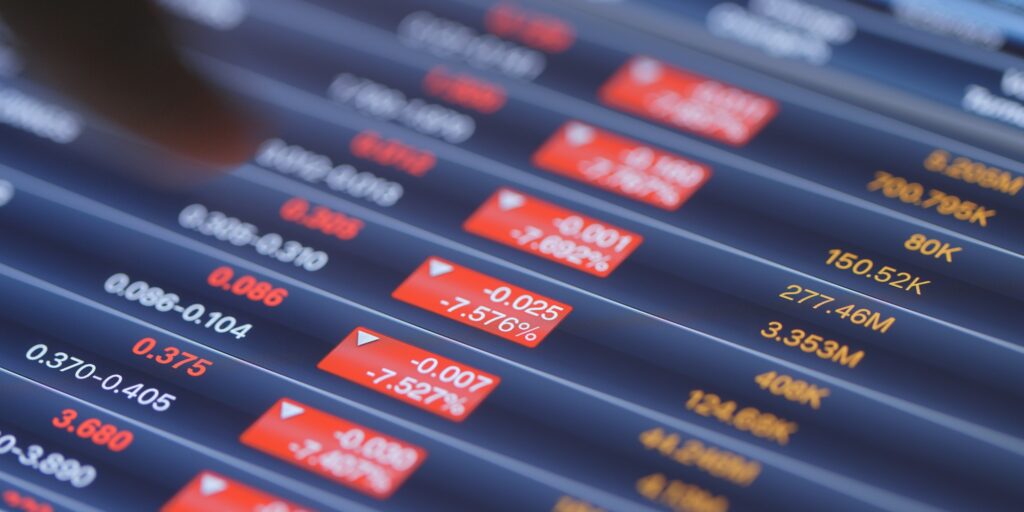
Yesterday, stock markets across the Western hemisphere were unanimously in the red. The average European stock closed 1.6% lower, while the Brussels-based Bel20 lost 2.4%. Heavyweight UCB (-10.1%) was the biggest loser. D’Ieteren released strong results after the closing bell, and could well swim against the tide today. In the United States, things were even worse. The S&P 500 fell 2.7%, while the Nasdaq dropped 4%. The 100 largest technology stocks collectively lost over 1,100 billion dollar in market value. Tesla was among the hardest hit, suffering a staggering 15.4% drop. President Donald Trump warned the American public about turbulent times ahead due to ongoing trade wars with Canada, Mexico, and China. He did not rule out a possible U.S. recession, which sent investors into a panic. Even Bitcoin could not escape the downturn, having lost 24% of its value since the end of January.
Asian markets have not escaped the selling pressure this morning, though their losses are notably smaller than in other regions. Stocks in both Japan and Hong Kong are down by about 1% on average. Later today, Volkswagen will report earnings in Germany, while U.S. department store chain Kohl’s will release its figures.
Crash Diet
Novo Nordisk (-8.1%) also declined alongside the broader market yesterday, though not without reason. This marks the second time in a short period that the Danish pharmaceutical company has published disappointing trial results. Test data for its weight-loss drug CagriSema fell short of expectations compared to similar treatments like Mounjaro and Zepbound from rival Eli Lilly (-4.5%). The weight-loss drug market is so lucrative that more competitors are entering the space. Swiss pharmaceutical giant Roche recently recruited employees from Novo Nordisk, signaling its ambition to develop its own weight-loss treatment. Since peaking in June last year, Novo Nordisk’s stock has been on a “diet” of its own, having lost nearly half of its market value.
Juggling Debt
Last year, investors were displeased when Belgian holding company D’Ieteren transferred additional debt onto its subsidiary Belron to fund a massive dividend payout. This move increased the debt ratio of Carglass’ parent company from 2.4 to 5.5 times its operating profit. Interest expenses rose to 338 million euro. However, the latest annual results show that Belron CEO Carlos Brito has not lost his touch when it comes to managing debt. Belron’s revenue grew 6.8% to 6.48 billion euro, while its profit margin expanded by 0.7% to 21.2%. This increase was more than enough to absorb the additional interest costs. Belron now accounts for about half of D’Ieteren’s total profit. The holding company reported a net profit of 1.065 billion euro, marking a 9.6% increase compared to 2023.
Did You Know…
that Volkswagen produced over 8.5 million currywurst sausages in 2024? These sausages are primarily offered as snacks to employees but can also be purchased in supermarkets. However, the German automaker still rolls out slightly more cars, with just over 9 million vehicles produced last year.
This article was translated from Dutch and was originally published on Spaarvarkens.be.
Responses