
Before the bell: oil prices down, stock prices up

There’s no sign of geopolitical tensions on the markets. Philips issues a profit warning, and the Indian IPO market appears overheated.
For the first time in six weeks, the S&P 500 recorded a weekly loss, down by 1% last week. On Friday, the S&P 500 was flat, while the Nasdaq managed a 0.6% gain on the last trading day of the week, ending the week with a slight gain of 0.2%. This gain is partly thanks to Tesla’s strong performance. Tesla’s stock rose by 22.9% in one week, and because it has a 2.42% weight in the Nasdaq Composite, this single stock contributed over half a percentage point to the index’s gains. On Friday, Tesla was up another 3.3%, while McDonald’s lost another 3%. For the week, the hamburger stock dropped by 7.7% after it disclosed a contamination issue. Chemical company Dow (-2.5%) and financial stocks Travelers (-2.3%) and Goldman Sachs (-2.3%) also lost ground on Friday, while Intel rose 1.5%, and Amazon, Microsoft, and Nvidia each gained 0.8% on the final trading day of the week. In Brussels, Umicore rose by 2.1%, while AB InBev and GBL each lost half a percent.
Oil prices are starting the new week down by 4.5% after it became clear that Israel’s attack on Iran did not impact oil infrastructure. Hong Kong’s stock market is up 0.3%. Yesterday, however, China’s National Bureau of Statistics reported that the combined profits of the country’s largest industrial companies were 3.5% lower in the first nine months of this year compared to last year. In Japan, the Topix rose by 1.8% after a weak start due to poor election results for the ruling parties. Ford and Philips are set to release their earnings today.
Warning light in Eindhoven
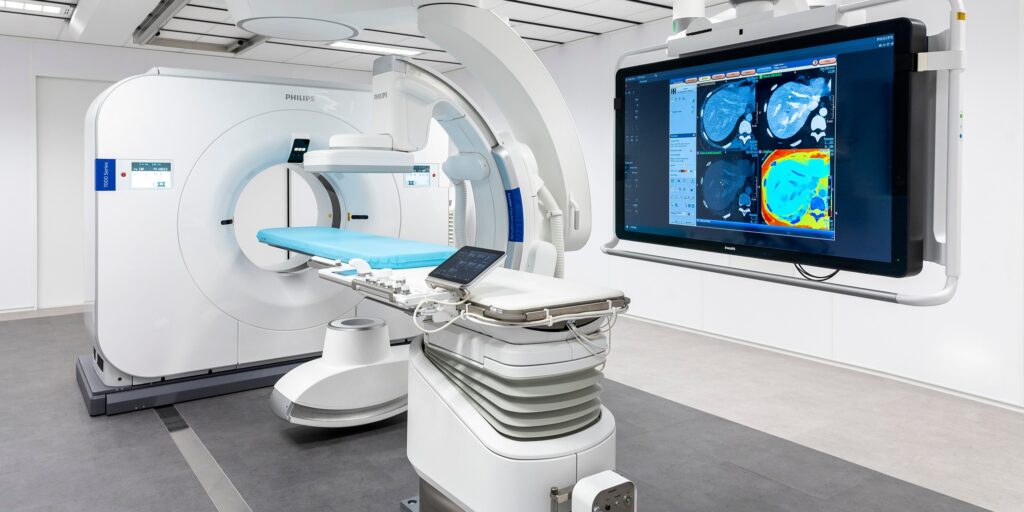
Philips announced its results this morning, and they were weak. The Eindhoven-based company posted an operating profit of €337 million on quarterly revenue of €4.4 billion, with an operating cash flow of €192 million. Revenue was disappointing, showing no year-over-year growth compared to the strong performance in the third quarter of 2023, when revenue rose by 11%. The company attributed the weak sales to lower demand in China, while other markets saw revenue growth. Philips attempted to soften the blow by reporting an increase in its profit margin from 10.2% to 11.8% of adjusted EBITA. However, it also lowered its full-year expectations. This profit warning is significant; three months ago, Philips expected full-year revenue growth of 3% to 5%, but now that figure is down to just 0.5% to 1.5%.
No free lunch
Last week, the Japanese stock market welcomed newcomer Tokyo Metro, which gained 47%. Meanwhile, the pace is slower on the Mumbai stock exchange, where Indian stocks have been falling for four consecutive weeks, making it more challenging to launch an IPO. Nevertheless, Swiggy, a major food delivery company, is planning to go public, though that ambition comes at a cost. Initially, the company aimed for a valuation of $15 billion, but now the figure has been adjusted down to $11.3 billion—a 25% drop. This valuation is still slightly higher than the $10.7 billion valuation set during the last funding round in 2022. Swiggy plans to list just over a tenth of its shares. The success of this IPO will also be significant for Prosus, as the investment company holds a stake in Swiggy.
Did you know…
that 270 companies in India have already gone public this year? Together, they raised $12.57 billion. For all of 2023, that figure was just $7.4 billion.
This article was translated from Dutch and was originally published on Spaarvarkens.be.
Responses